library(tidyverse)
library(readxl)

path = "Excel/644 Total Cost.xlsx"
input = read_excel(path, range = "A2:B17")
test  = read_excel(path, range = "D2:E6")

result = input %>%
  mutate(Name = ifelse(is.na(Cost), `Name & Category`, NA)) %>%
  fill(Name, .direction = "down") %>%
  summarise(`Total Cost` = sum(Cost, na.rm = T), .by = Name)

all.equal(result, test)
#> [1] TRUEExcel BI - Excel Challenge 644
excel-challenges
excel-formulas
🔰 List All names and total cost against each name.
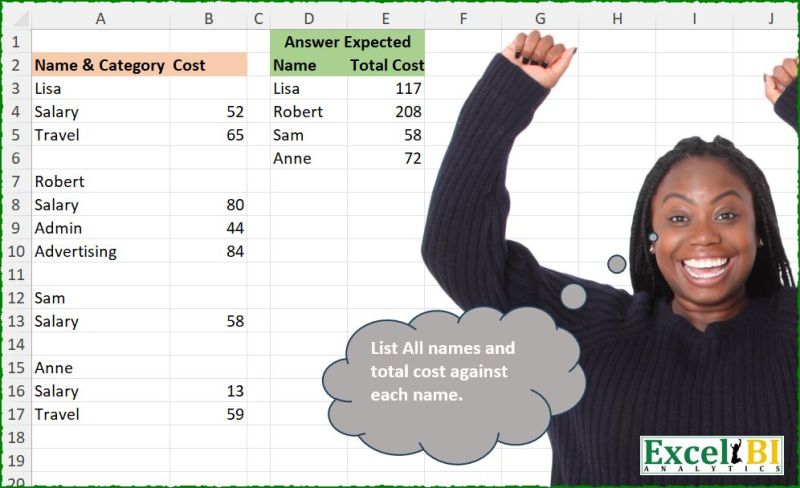
Challenge Description
🔰 List All names and total cost against each name.
Solutions
- Logic: Read the workbook ranges needed for the challenge; Derive the required intermediate columns; Aggregate or rank the data at the required grouping level; Apply the business rule conditions explicitly.
- Strengths: The code maps the workbook rule into a compact, reproducible pipeline.
- Areas for Improvement: The solution assumes the workbook layout and selected ranges remain stable, so any structural change in the sheet would require small adjustments.
- Gem: The elegant part is how little code is needed once the correct intermediate representation is chosen.
import pandas as pd
import numpy as np

path = "644 Total Cost.xlsx"
input = pd.read_excel(path, usecols="A:B", skiprows=1, nrows=16)
test = pd.read_excel(path, usecols="D:E", skiprows=1, nrows=4).sort_values('Name').reset_index(drop  = True)

input['Name'] = input['Name & Category'].where(input['Cost'].isna()).ffill()
result = input.fillna({'Cost': 0}).groupby('Name')['Cost'].sum().reset_index().rename(columns={'Cost': 'Total Cost'})
result['Total Cost'] = result['Total Cost'].astype(np.int64)

print(result.equals(test)) # True
The Python version follows the same grouped logic and keeps the transformation explicit in a dataframe pipeline.
Difficulty Level
Easy / Medium
The business rule is clear, though the workbook still needs a few transformation steps to reach the expected output.