library(tidyverse)
library(readxl)

path = "Excel/638 Days of the Week Abbreviation.xlsx"
input = read_excel(path, range = "A2:C9")
test  = read_excel(path, range = "D2:F9")

abbreviate = function(column) {
  for (i in seq_len(nchar(column[1]))) {
    abbrs = substr(column, 1, i)
    if (length(unique(abbrs)) == length(column)) {
      return(abbrs)
    }
  }
}

result = input %>%
  mutate(across(everything(), ~ abbreviate(.)))

all.equal(result, test, check.attributes = FALSE)
#> [1] TRUEExcel BI - Excel Challenge 638
excel-challenges
excel-formulas
🔰 Given are Day of week names in 3 languages.
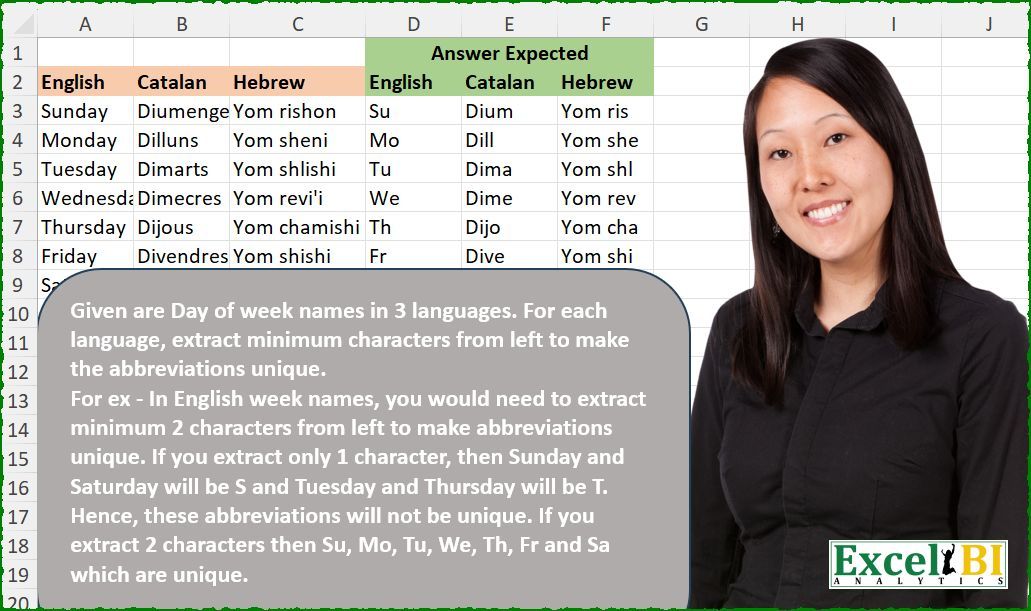
Challenge Description
🔰 Given are Day of week names in 3 languages. For each language, extract minimum characters from left to make the abbreviations unique. For ex - In English week names, you would need to extract minimum 2 characters from left to make abbreviations unique. If you extract only 1 character, then Sunday and Saturday will be S and Tuesday and Thursday will be T. Hence, these abbreviations will not be unique. If you extract 2 characters then Su, Mo, Tu, We, Th, Fr and Sa which are unique.
Solutions
- Logic: Read the workbook ranges needed for the challenge; Derive the required intermediate columns; Iterate through the sequence until the rule is satisfied.
- Strengths: The algorithm is explicit about the sequence rule, so the control flow is easy to validate against the prompt.
- Areas for Improvement: The solution assumes the workbook layout and selected ranges remain stable, so any structural change in the sheet would require small adjustments.
- Gem: The non-obvious part is the local rule inside the loop, because that rule determines the whole output.
import pandas as pd

path = "638 Days of the Week Abbreviation.xlsx"
input = pd.read_excel(path, usecols="A:C", skiprows=1, nrows=8)
test = pd.read_excel(path, usecols="D:F", skiprows=1, nrows=8).rename(columns=lambda x: x.split('.')[0])

result = input.apply(lambda col: next(col.str[:i] for i in range(1, len(col[0]) + 1) if len(col.str[:i].unique()) == len(col)))

print(result.equals(test)) # True
The Python version keeps the algorithm explicit, which helps when the challenge depends on a greedy or iterative rule.
Difficulty Level
Medium / Hard
The challenge relies on a non-obvious iterative rule rather than a single straight aggregation.